For shoppers who want practical home products without overlooking sustainability, ReBorn offers a distinctive approach to everyday homewares. The brand focuses on turning discarded plastic from industrial waste into useful, attractive products for kitchens, bathrooms, storage spaces and recycling areas.
Rather than treating sustainability as something separate from good design, ReBorn brings the two together. Its products are designed to be functional, durable and visually appealing while being made in the UK from recycled materials.
Homewares with a Different Starting Point

The most interesting aspect of ReBorn is where its products begin. Instead of relying on newly manufactured plastic, the company uses discarded materials such as polypropylene and TPE collected from factories around the UK.
These materials are sorted, cleaned and processed into pellets before being transformed into new household products at the brand’s factory in Wiltshire. This gives industrial waste a second life while reducing the need for virgin materials.
The approach is central to the identity of ReBorn, which aims to create homewares that can themselves eventually be reused, repaired or recycled.
A Collection Built Around Everyday Tasks

The range available from ReBorn focuses on practical products that people can use every day. The kitchen collection includes washing-up bowls, sink tidies, draining racks, utensil holders, cutlery drainers and kitchen roll holders.
There are also bathroom products, recycling bins, storage solutions, replacement parts and product bundles. This makes the range more comprehensive than simply offering a handful of environmentally conscious accessories.
One example is the ReBorn washing-up bowl. It has a generous capacity, large carry handles, elevated legs and an integrated plug that can be used for draining water. Its components can also be separated for easier cleaning.
The sink tidy follows the same philosophy, combining separate compartments, a non-slip base and a sloping design intended to keep excess water under control.
Designed to Be Practical as Well as Sustainable
A key point about ReBorn is that sustainability is not presented as a compromise on functionality. Products are designed around everyday household requirements, with attention given to storage, cleaning, space efficiency and ease of use.
The brand describes this approach as circular design. Individual components are designed so that products can be repaired and, when they eventually reach the end of their useful life, recycled more easily.
This is particularly relevant for household products that are frequently replaced because a small component breaks or wears out. The availability of replacement parts helps extend the useful life of selected products instead of encouraging customers to replace an entire item.
Made in Britain
Local production is another important difference between ReBorn and many conventional homeware brands.
The company’s products are made and packaged at its Wiltshire factory, using materials sourced from waste streams in the UK. Its packaging is also produced in the UK and uses FSC-certified, largely recycled materials.
This local manufacturing model forms part of the company’s wider sustainability strategy. By producing products closer to the market where they are sold, ReBorn aims to reduce the transport associated with importing comparable homewares from overseas.
The company states that its recycled-material production approach can result in significantly lower lifecycle carbon emissions than equivalent products made from virgin materials overseas.
A Stylish Approach to Kitchen Organisation
Sustainable products are sometimes associated with purely functional designs, but ReBorn places considerable attention on appearance as well.
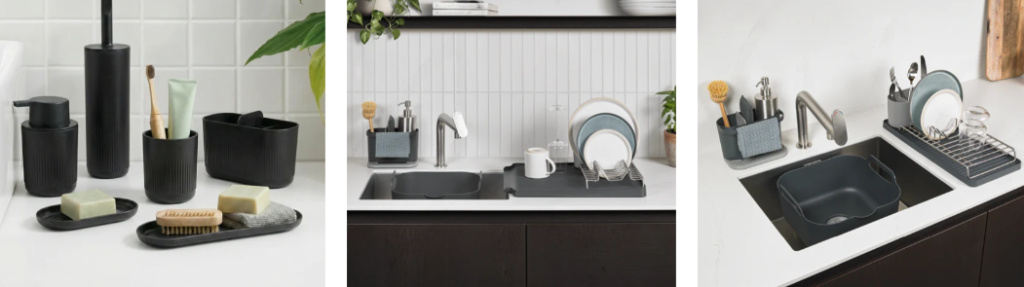
Products are available in carefully selected colours such as dark grey, stone and sage green, allowing practical accessories to complement contemporary kitchens rather than simply disappearing into cupboards.
The coordinated approach is particularly apparent in the kitchen bundles. Customers can combine several products from the same range, creating a more consistent look around the sink and worktop.
The Kitchen Range Bundle, for example, brings together six products including a large draining rack, washing-up bowl, sink tidy, cutlery drainer, kitchen roll holder and utensil holder.
What You Can Find on the Website
The ReBorn website is structured around several areas of the home. Customers can browse kitchen products, bathroom items, recycling bins, storage solutions, replacement parts, best sellers and bundles.
Product pages provide practical details such as dimensions, materials and features. The website also explains the reasoning behind the company’s manufacturing process and circular design philosophy.
There is a dedicated section covering the brand’s story and sustainability principles, while its blog provides additional information about new products, colours, design ideas and the company’s progress.
This educational side is useful because customers can understand not just what a product does, but also why it has been designed and manufactured differently.
What Makes ReBorn Different?
The main distinction of ReBorn is that sustainability is incorporated into the entire product journey. The company starts with waste materials, manufactures locally, designs products with repair and recycling in mind, and aims to avoid unnecessary replacement.
Its combination of recycled plastic, UK manufacturing, practical design and coordinated styling gives the brand a clear identity within the homewares market.
Many household products are designed primarily around price and convenience, while environmental considerations may come later. ReBorn takes a different route by making responsible material use part of the original design process.
A Modern Take on Responsible Homewares
For households looking to make more considered purchasing decisions, ReBorn offers an interesting alternative to conventional plastic homewares. Its products combine familiar household functions with recycled materials, British manufacturing and circular design principles.
From washing-up bowls and sink organisers to recycling products, bathroom accessories and replacement components, the collection focuses on useful objects that can become part of everyday routines.
By transforming waste into well-designed household essentials, ReBorn demonstrates that practical home products can also have a stronger focus on material reuse, local production and long-term usability.